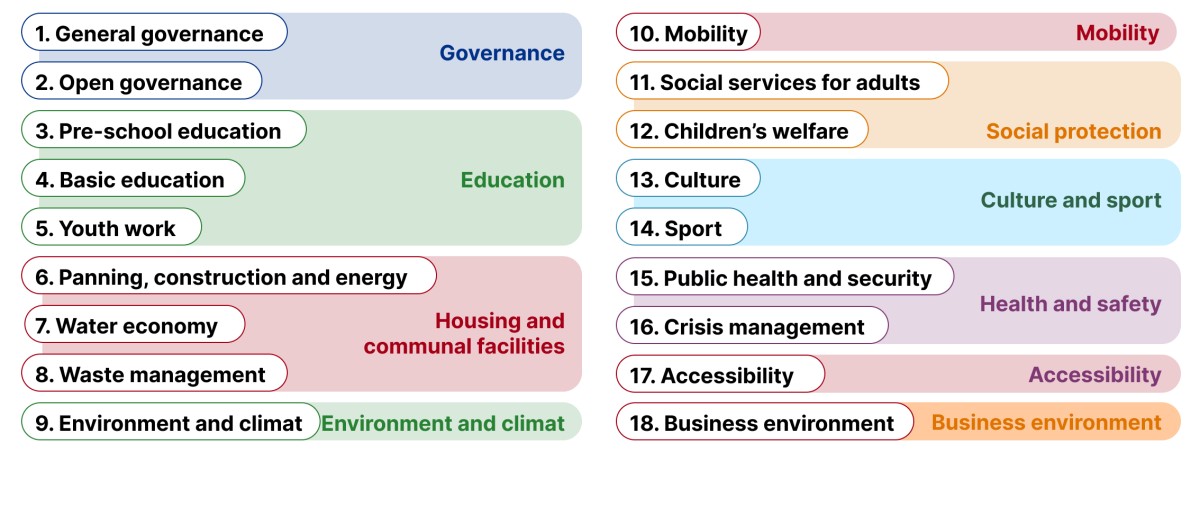
The website Minuomavalitsus.ee evaluates public services of local governments in 18 areas. As there are many evaluated services, related services are grouped together for a simpler overview. For example, primary education, basic education, and youth work are grouped together as the education field, and adult care and children's welfare are grouped together as social protection. The service level has been calculated as the arithmetic mean of the services included in the service group. The service level has been calculated for both service groups and individual services.
How is the service level calculated?
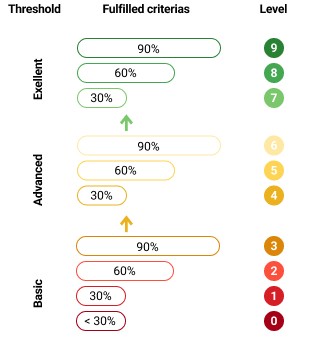
The service level for each municipality in every area is calculated on a scale from zero to nine based on the fulfillment of evaluation criteria. The more evaluation criteria a municipality satisfies, the higher its level of service. Each field has dozens of evaluation criteria, each with up to three metrics: Basic, Advanced, and Excellent. The Basic level metrics assess a municipality's performance in fulfilling tasks required by law and providing essential services to its residents. Advanced level metrics show what is expected of a successful municipality, and Excellent level metrics evaluate its use of innovative solutions and additional capabilities to enhance the welfare of the population.
Not all evaluation criteria have metrics at all three levels. While some criteria have metrics at all three levels, others have metrics at two or one level only.
Metrics for various thresholds of evaluation criteria contribute to different parts of the service level scale. Basic metrics contribute to a scale of 0-3, Advanced threshold metrics to a scale of 4-6, and Exellent threshold metrics to a scale of 7-9.
To achieve service level 3, the municipality must surpass 90% of the Basic level metrics. If it exceeds only 60% of the Basic level metrics, it reaches level 2, and if only 30%, it remains at service level 1. The same percentages apply to the Advanced and Exellent threshold metrics. The service level is determined by adding up the points earned at all three threshold levels. However, there is a rule in the evaluation methodology: if the municipality has not fulfilled 90% of the Basic level metrics, it cannot earn full points for fulfilling the Advanced and Exellent level metrics. In this case, 50% fulfillment of either level's metrics earns 1 extra point. For example, if the municipality fulfills 90% of the Advanced level metrics but falls below 90% for the Basic level, it earns 2 points from the Basic level metrics and only 1 additional point from the Advanced level. This totals to service level 3. However, if the municipality also reaches 90% at the Basic level, all points earned from the 3 Advanced threshold levels are considered, and the municipality reaches level 6.
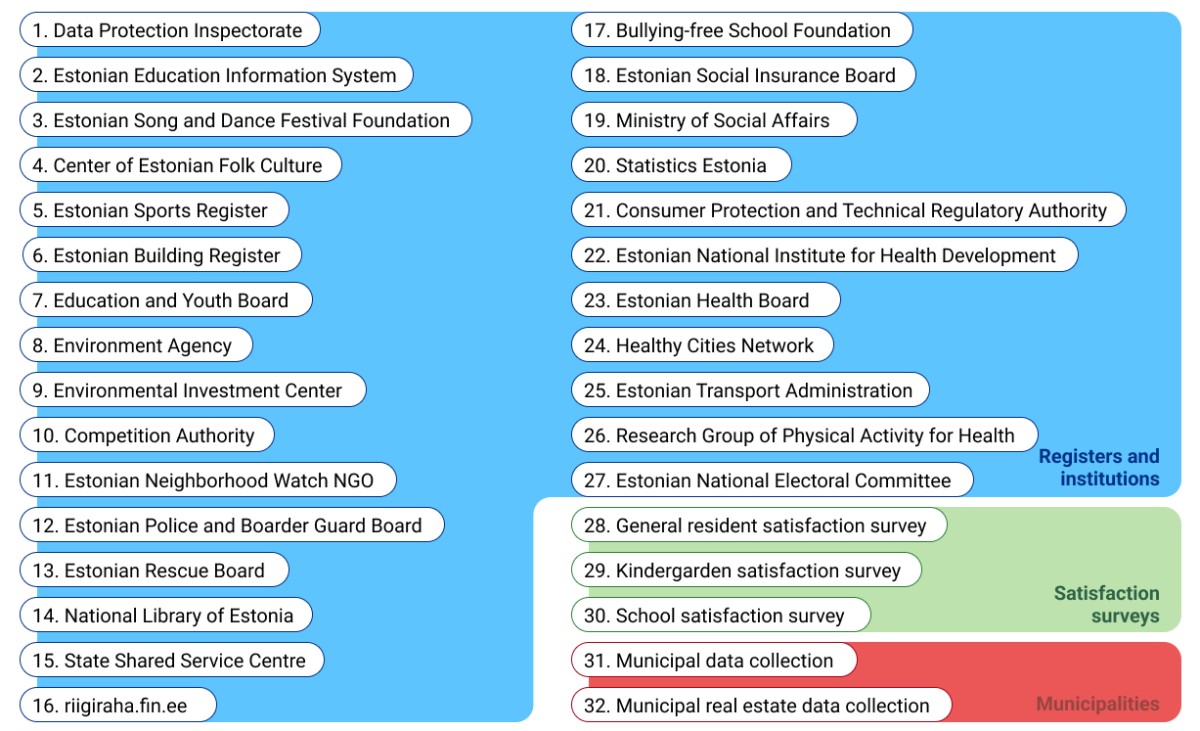
Data for evaluation criteria come from over 30 different sources. The sources can be broadly divided into three:
- Registers and institutions
- Municipalities
- Resident satisfaction surveys
Read more about data sources and the regularity of data updates here.
The data is updated on an annual basis, with the exception of the residents' satisfaction survey, which is updated every two years. However, in some areas and for certain evaluation criteria, the data is updated or corrected multiple times throughout the year.
You can find more info about the data sources and the frequency of data updates here.
The evaluation methodology comprises of more than 700 metrics that are evaluated for timeliness and appropriateness by working groups within each field. Each working group includes representatives from local governments, central government, and residents. The Union of Estonian Cities and Towns, together with heads of specific municipalities, department heads, specialists, and/or heads and specialists of subordinate institutions, represent local governments in working groups. The central government is represented by specialists from the ministries and their subordinate institutions. Various civil associations represent the views of Estonian people. The list of institutions that belong to working groups can be found here.
The selection of metrics by all working groups follows the general principle that each selected metric must reflect the qualitative level of the service. Statistical indicators are not included in the evaluation of services.
Last updated: 30.10.2024