
As one drives across the country, is everyone equally as happy? In a first blog on the satisfaction of Estonians with where they lived, we saw that the overall level of satisfaction was quite high, according the survey conducted in the summer 2021 (see box below for details).
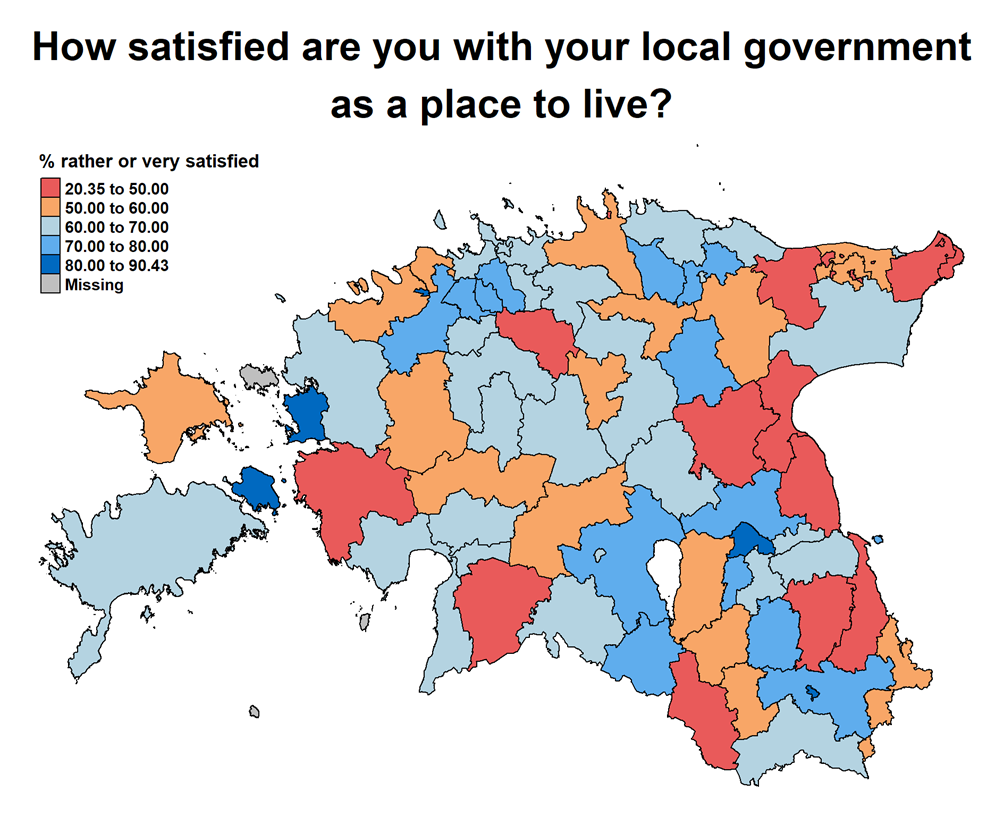
However, not everyone is happy with where they live. Map presented below illustrates that, contrary to the national average of 62% of people being satisfied with their local environment, in some municipalities as few as 20-30% of people are satisfied, whereas some others this value was over 80%.
There are certain discernible spatial trends, such as dissatisfied respondents more frequently coming from the eastern parts of the country, or the satisfied ones largely concentrating around Tallinn and Tartu. Yet, the pattern is by no means clear, as we can also observe that in the Harju maakond, the bordering municipalities of Kose vald and Kiili vald exhibit over 24 percentage points difference in the share of satisfied residents; or that Lääneranna vald, with 36% satisfaction rate, sits just across a 8 kilometers-long Suur Strait from the Muhu vald, which with 90% satisfaction rate is the most satisfied municipality in the country.
Survey details
Survey details
The survey was conducted online, between June and October of 2021. In total, a sample of 7,219 people from across 76 municipalities provided their responses to a two-part survey. In the first part, the respondents were able to express the feelings about their local governments, including aspects such as efficiency and responsiveness of the policy-makers. In the second part, they could use a novel survey tool, called quadratic voting for survey research (QVSR), and assume the role of local policymakers to decide how to distribute a ‘budget’ of votes for future spending on 16 different types of local public services - from pre-school education, through waste management, to sports. As a decision-making tool, QVSR is increasingly attracting the attention of both academics and policy-makers (see here). The survey was concluded shortly before recent local government elections, held in October 2021. As such, its results should not be viewed not as an evaluation of the performance of the current local authorities, whose mandate started only after they survey had finished collecting citizens’ feedback. Rather, it should be seen as a potential input in deciding on reforms and new policy directions by the incoming local decision-makers.