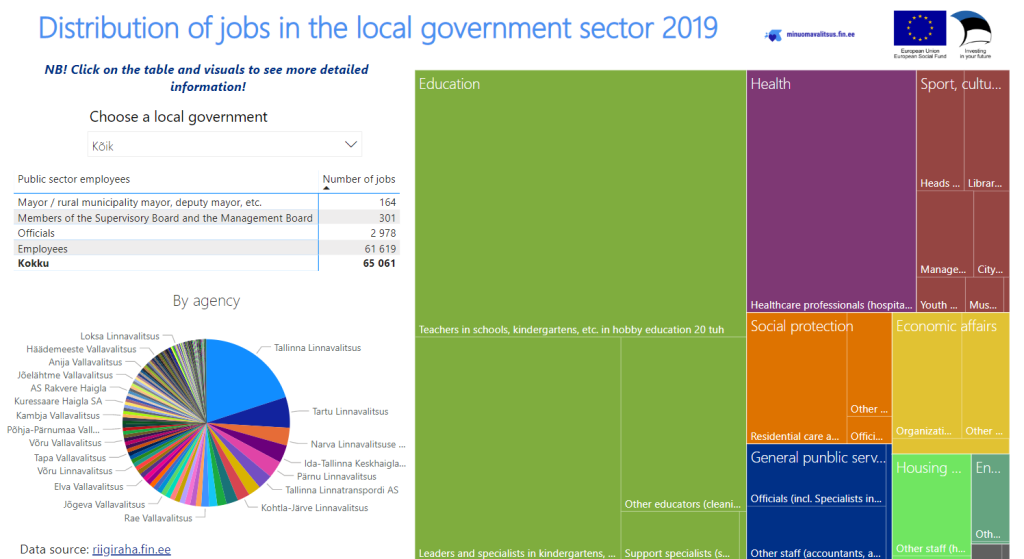
If we divide people in two on the basis of employment, 5% (i.e. 3 thousand) of them are officials and 95% (62 thousand) are employees. By sector, the majority, i.e. 58% of employees (i.e. 36 thousand) work in kindergartens, schools and institutions providing youth hobby education, 14% (i.e. 9 thousand) in municipally owned hospitals, GP centers or other health care institutions. Municipalities own 26 hospitals, clinics and health centres (e.g. county hospitals, East Tallinn Central Hospital, West Tallinn Central Hospital, etc.). 8% (i.e. 5 thousand) of the employees work in libraries, cultural, sports and youth work institutions and 6% (i.e. 4 thousand) of the total employees provide social services.
But how many employees work in the city or rural municipality government? The general government sector accounts for about 8% of all employment relationships. However, if we illustrate the situation and look at one median local government (approx. 8,000 inhabitants), then one mayor and approx. 25 officials (i.e. field managers, advisors and specialists) work in one local government. There are about 400 other employees, of whom 230 work in education, 35 in health care, 22 in social welfare, 40 in culture, sports, youth work and the rest (5%) help in housing, environmental protection and other areas of the economy.
* The analysis and preparation of the article is supported by the European Social Fund of the European Union.